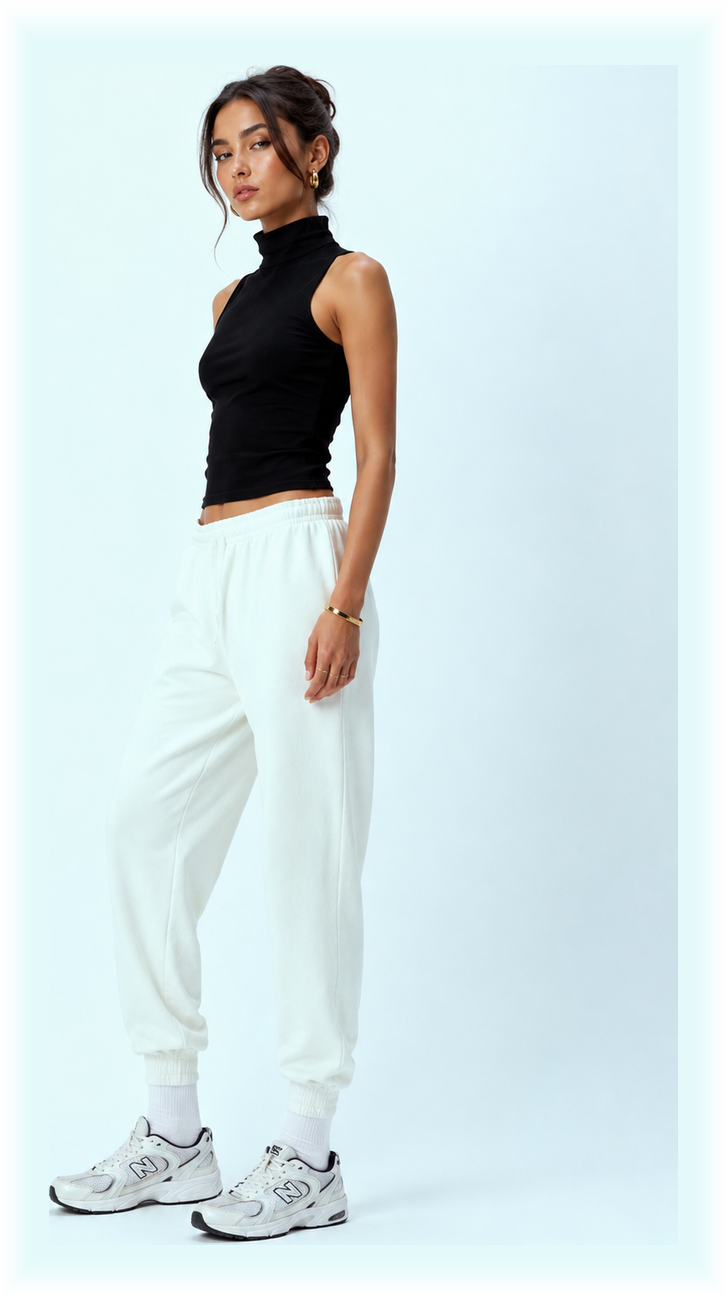
A style uniform is one silhouette formula — say, wide-leg trouser, fitted knit, structured layer — repeated daily with variation only in color and fabric. It works because the outfit decision gets made once, deliberately, instead of every morning under time pressure; building one means finding the outfit you already repeat on good days and refining it into a formula worth committing to.
The uniform has a lineage — artists, architects, editors who wear a version of the same thing daily and look sharper for it, not lazier. The logic holds off the pedestal too: a formula designed once, deliberately, outperforms three hundred separate 7am decisions made under time pressure, and the repetition itself becomes the signature. Nobody remembers that the outfit repeated; they remember that it worked.
The raw material already exists. Every closet has the outfit that gets reached for on the days that matter — the combination that produces the small, reliable feeling of being dressed correctly. That repeat is the uniform announcing itself. The build step is naming it as a formula rather than an outfit: not 'the navy trousers and the gray knit' but 'straight trouser, fine-gauge knit, structured third layer, low profile shoe.'
Abstracted to slots, the formula multiplies without changing. Five trousers in the same cut across different colors, six knits, two jacket weights — a month of visibly distinct outfits, every one of them pre-solved. Variation lives inside the slots (color, fabric, weight); the silhouette stays fixed. That's the difference between a uniform and a rut: a rut is accidental sameness, a uniform is designed sameness with room to breathe.
Two honest boundaries. A uniform needs a defined jurisdiction — most lives need two formulas, a working one and an off-duty one, and forcing one to cover both breaks it. And it needs a probation period: two weeks of committed wear before any duplicate-buying, because a formula that chafes in week one isn't the formula. Refine the slot that fails; keep the rest.
Draped is close to purpose-built for this: set the formula once, render candidate pieces on your own photo against the fixed silhouette, and audition slot-fillers in minutes — so the uniform deepens over time instead of drifting.
The formula
The found repeat
The outfit already reached for on days that matter — the uniform announcing itself.
The abstraction
Name it as slots — 'straight trouser, fine knit, structured layer' — not as specific garments.
The probation
Two weeks of committed wear before buying any duplicates. Refine the slot that fails.
The multiplication
Vary color and fabric inside fixed slots. Designed sameness, not accidental sameness.
The second uniform
Work and off-duty are different jurisdictions — most lives need one formula for each.
See it on you, not a model
Draped renders personal style on your own photo before you buy a thing. Invite-only beta, opening up slowly.
Get the beta inviteQuestions people actually ask
Isn't wearing a uniform boring?
The color and fabric still change daily — what disappears is the low-grade morning negotiation, not the variety. In practice a good uniform reads as signature, not repetition; the people known for dressing well are disproportionately uniform-wearers.
How many pieces does a style uniform need?
Enough to fill each slot for a laundry cycle — typically four or five bottoms, five or six tops, two or three layers in the fixed silhouette. Most of it is usually already owned by the time the formula gets named.
What if I get tired of my uniform after a few months?
Change one slot, not the system — swap the trouser cut or the third layer and let the rest hold. A uniform is meant to evolve by increments; scrapping it entirely usually just restarts the morning negotiation it existed to end.